
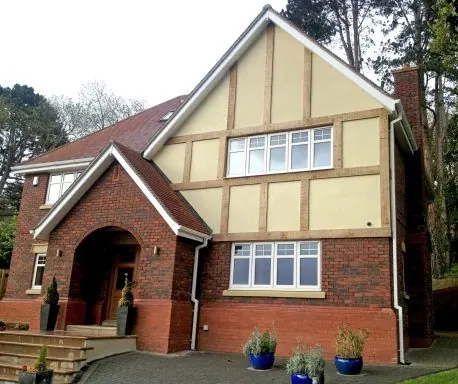
Conservation area planning permission depends on the work you want to do and the rules affecting your particular property. Being in a conservation area does not automatically mean every extension needs planning permission, but some permitted development rights are more restricted. Article 4 Directions can remove further rights, and demolition and tree work have separate controls. Before making changes in North Wales or Cheshire, check the property’s conservation-area boundary and ask the local planning authority which rules apply.
How does being in a conservation area affect my plans?
A conservation area is designated for the special architectural or historic interest of a place as a whole. That may include its buildings, street pattern, boundaries, trees, views and open spaces, not just individual landmark buildings. In Wales, more than 500 conservation areas have been designated under Part 4 of the Historic Environment (Wales) Act 2023.
The local planning authority must give special regard to preserving or enhancing a conservation area’s character or appearance when making planning decisions. This doesn’t rule out change, but means the design, scale, position and materials of a proposal matter. Planning Policy Wales, Chapter 6 and Technical Advice Note 24 provide national policy and guidance.
The local picture is varied. Conwy County Borough has 25 conservation areas, including Colwyn Bay Town Centre, Old Colwyn and Pwllycrochan. Denbighshire’s published guidance lists 33, including areas in Rhyl, Ruthin and Denbigh. In Cheshire West and Chester, the council lists 96 conservation areas, including parts of Chester, Malpas, Tattenhall, Tarvin and Great Budworth. Check the current boundary and local guidance for your address: a town name alone won’t tell you whether your property is included.
Do I need planning permission for an extension or alteration?
Not necessarily. Some work may still qualify as permitted development, work that can go ahead without a planning application, if it meets the relevant rules. But in conservation areas, particular permitted development rights for houses are more limited. Wrexham County Borough Council identifies restrictions that can affect roof extensions and rooflights, cladding, chimney removal, satellite dishes and raised decking, among other work.
The exact rule depends on the type and location of the proposal, and whether another restriction applies. An Article 4 Direction may also remove rights that would otherwise apply. That’s why it’s worth checking before assuming an extension or external alteration is permitted development. Our guide to whether you need planning permission for an extension in 2026 explains the wider householder checks.
What is an Article 4 Direction?
An Article 4 Direction is a local legal measure that removes specified permitted development rights. It can mean that work which would usually be allowed without an application instead needs planning permission. The direction applies only to the rights and properties it identifies, so check the relevant council’s maps and guidance.
In Wrexham County Borough, the council reports 12 Article 4(2) Directions across 11 conservation areas, including Bangor on Dee, Cefn Mawr, Chirk, Holt, Overton, Rossett and Ruabon. Where a direction applies, permission may be required for changes such as enlarging a house, changing external materials, replacing windows or doors, altering the roof, or altering boundary walls facing a highway, footway, waterway or open space. Denbighshire also uses Article 4 Directions in some areas.
Wrexham Council says there is no application fee for an application required solely because of an Article 4(2) Direction. Check with your own local authority, as both the controls and fees can depend on the circumstances.
Can I demolish a building, wall or boundary?
Demolition has its own rules. In Wales, the general position is that conservation area consent is needed to demolish an unlisted building in a conservation area, unless an exemption applies. The Welsh Government’s 2024 Procedure Regulations disapply the consent requirement for certain classes of building.
As a general guide, consent is required for demolition of a building over 115 cubic metres. It is also generally required to demolish a gate, fence, wall or railing over 1 metre high next to a highway, waterway or open space, or over 2 metres high elsewhere. Check the proposed work and any exemptions with the local planning authority before demolition begins.
Consent for demolition is not the same as planning permission for what might replace it. The authority may expect a valid redevelopment proposal and details of how the site will be treated afterwards. A heritage impact statement is required with a conservation area consent application. Cadw’s guidance on heritage impact assessment explains the process.
Do I need permission to prune or remove a tree?
Often, you need to give the local planning authority six weeks’ written notice before cutting down, topping or lopping a tree in a conservation area if its stem diameter is 75mm or more, measured 1.5 metres above ground. The notice gives the authority time to decide whether the tree should be protected by a Tree Preservation Order. Carrying out qualifying work without the required notice may be a criminal offence.
A tree already protected by a Tree Preservation Order is subject to separate controls; you may need consent for work. Check the tree’s status and the council’s process before arranging pruning or removal.
What design and materials are more likely to be acceptable?
There isn’t one style that suits every conservation area. A successful proposal responds to what makes its particular setting distinctive: perhaps the proportions and rhythm of a street, local stone or brick, traditional window patterns, roof shapes, mature planting or the way buildings meet the pavement.
That doesn’t mean new work must copy the old. It does mean the design needs to show how the change will preserve or enhance the area’s character. A clear understanding of the site, appropriate materials and well-resolved details can help make a contemporary extension feel considered rather than out of place. For listed buildings, listed building consent may also be needed; it is separate from planning permission.

Penrhyn Architecture works on homes in conservation areas, including Oakwood in Colwyn Bay, as well as listed-building renovation and barn conversion projects. Our work in the region also includes Colwyn Heights. Each property and project has its own planning context; previous work is not a guarantee that a similar proposal will be approved.
What should I check before starting work?
Before finalising a design or asking a builder to begin, it helps to:
- Confirm the conservation-area boundary with your local planning authority.
- Check whether an Article 4 Direction or planning condition applies to your property.
- Establish whether the proposal needs planning permission, conservation area consent, listed building consent or another approval.
- Check whether tree notice or Tree Preservation Order controls apply.
- Review the area’s appraisal or management guidance, where available.
- Speak to the council or an architect if the rules are unclear.
Planning permission and building regulations are separate processes. Even where planning permission is not needed, building regulations may apply to the work. Our guide to building regulations drawings explains how technical drawings support the construction stage.
Penrhyn Architecture has more than 20 years’ experience. We prepare and submit planning applications, and take a collaborative, builder-friendly approach, considering practical construction requirements and sustainability as the design develops. For further budgeting, see our guides to extension cost per square metre, single-storey extension costs and house extension cost in North Wales.
Frequently asked questions
Do I need planning permission for an extension in a conservation area in Wales?
Not automatically. Some extensions may qualify as permitted development, but conservation-area restrictions and an Article 4 Direction can change what is allowed. Check the rules for your address and proposal with the local planning authority.
What is an Article 4 Direction?
It is a local direction that removes specified permitted development rights. If it covers your property and the work involved, you may need planning permission for changes that would otherwise be permitted development.
Can I remove a wall or tree in a conservation area?
It depends on the work. Demolishing certain buildings or boundary structures may require conservation area consent. For qualifying trees, six weeks’ written notice is generally required before work, unless separate Tree Preservation Order controls apply. Check with the council before proceeding.
Does conservation area status mean my extension will be refused?
No. It means the authority will assess the proposal’s effect on the area’s character or appearance. A well-designed scheme that responds to its setting can still be considered.
If you’re planning a change to a home in North Wales or Cheshire and would like to understand the likely approvals, you’re welcome to book a free consultation with Penrhyn Architecture. It’s a calm first conversation, with no pressure to proceed.